
Can You Deduct Uber & Lyft Passenger Amenities?
By Egor · Updated · 5 min read · Rideshare & delivery

Yes, rideshare drivers operating as independent contractors can generally deduct passenger snacks, water, and music subscriptions used exclusively to improve the rider experience. These count as ordinary and necessary business expenses on Schedule C, lowering both income and self-employment taxes.
If you drive for Uber or Lyft, offering extra perks like cold water bottles, mints, or a ad-free music subscription can help keep your rating high and your tips flowing. But when tax season rolls around, can you write off these extra costs?
Here is a clear look at how an uber lyft passenger amenities write off works, what the IRS expects, and how to track these expenses alongside your daily mileage.
Are Passenger Amenities Tax-Deductible?
Yes. As a 1099 independent contractor, you report your rideshare income and expenses on Schedule C. The IRS allows you to deduct expenses that are both "ordinary" (common in your trade) and "necessary" (helpful and appropriate for your business).
Perks provided exclusively for your passengers fall under ordinary business expenses. Because these expenses reduce your net business income, they directly lower what you owe in federal income tax and self-employment tax.
Self-employment tax is 15.3% applied to 92.35% of your net self-employment earnings. That means every legitimate dollar you write off saves you money on both income tax and self-employment tax.
Deductible Amenities
You can typically deduct 100% of the cost for items bought solely for rider comfort: * Bottled water and soda: Purchased for passengers in your car. * Snacks and candy: Mints, gum, chips, or individually wrapped treats. * Charging cables: Extra Lightning, USB-C, or multi-head cables kept in the back seat for riders. * Comfort items: Tissues, hand sanitizer, or back-seat trash bags.
Music and Media Subscriptions (Spotify, Pandora, SiriusXM)
Can you deduct a music subscription like Spotify or Pandora?
- 100% Business Use: If you maintain a dedicated premium music account strictly to play ad-free music for passengers while working, the full cost is generally deductible.
- Mixed Business and Personal Use: If you use the exact same Spotify account at home, at the gym, or for personal driving, you can only deduct the business portion. You must allocate the cost reasonably based on how much the account is used for work versus personal enjoyment.
From the Road — Small Expenses Add Up
As an independent field service technician in the Dallas area, I understand how easily small business expenses can go unnoticed. Whether it's charging cables, bottled water, work supplies, or monthly subscriptions, individual purchases may seem insignificant, but they can add up over an entire year.
For rideshare drivers, the same principle applies to passenger amenities. Keeping business purchases separate from personal expenses makes it much easier to review spending and identify potentially deductible costs at tax time.
The key is not just earning money, but understanding how much it costs you to earn it.
— Yehor, Field Service Technician & VaultHub Developer
How Amenities Compare to the Standard Mileage Rate
Many drivers confuse car expenses with general business expenses. It helps to keep them strictly separate.
When you use the IRS standard mileage rate, it covers vehicle-related costs like gas, oil changes, insurance, depreciation, and repairs. For reference, the IRS business standard mileage rate for 2025 is 70 cents per mile. For 2026, the IRS rate is 72.5 cents per mile from January 1 through June 30, and rises to 76 cents per mile starting July 1, 2026.
However, passenger amenities are not car expenses. You can write off snacks, water, phone chargers, toll fees, and parking fees on top of claiming the standard mileage rate.
| Expense Category | Covered by Standard Mileage Rate? | Tax Treatment |
|---|---|---|
| Gas, Oil & Maintenance | Yes | Covered by the cents-per-mile rate |
| Insurance & Vehicle Depreciation | Yes | Covered by the cents-per-mile rate |
| Business Parking & Tolls | No | Deductible separately in full |
| Passenger Snacks & Water | No | Deductible separately as business supplies |
| Rider Music Subscriptions | No | Deductible separately (pro-rated if mixed use) |
Rules for Keeping IRS-Compliant Records
If you want to claim an uber lyft passenger amenities write off safely, standard recordkeeping rules apply. The IRS requires clear proof of your business expenses in case of an audit.
- Keep Itemized Receipts: A simple bank statement line showing a $150 total at Target is not enough. You need the itemized receipt showing you bought water bottles, mints, or cables.
- Separate Business Purchases: Try to buy passenger amenities on a separate transaction or dedicated business credit card so personal groceries do not mix with work supplies.
- Track Your Mileage Accurately: Claiming amenities without tracking your actual business drives looks incomplete. Your mileage log should record the date, business miles, destination, and work purpose for every shift at or near the time of the trip.
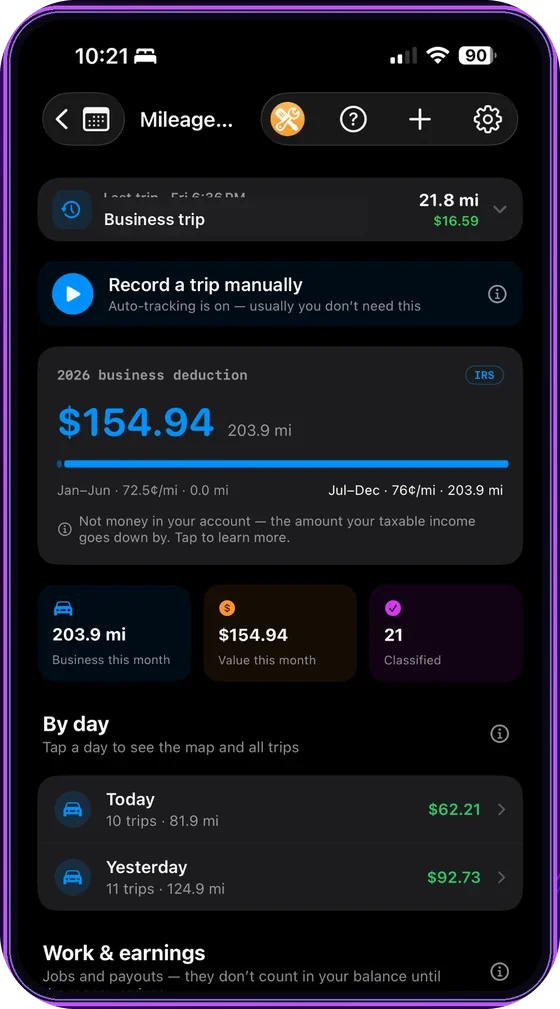
Using an automated app like VaultHub allows you to log business miles effortlessly alongside your overall work finances. VaultHub runs on your iPhone using motion sensors to record drives, calculates deduction values at the exact IRS rate for the trip date, and keeps your data private on your personal iCloud without requiring bank logins.
Commuting vs. Business Driving
Remember that driving from your home to a regular workplace or your first passenger pickup area is generally considered non-deductible commuting. However, driving between passenger pickups, navigating to busy staging areas, or running a dedicated trip to buy work supplies (like driving to a store specifically to buy passenger snacks) counts as business mileage.
Because tax rules can vary depending on your overall financial picture, consult a qualified tax professional if you have unique questions about your Schedule C deductions.
One of the reasons I developed VaultHub was to bring mileage tracking, business expenses, income, and recurring payments together in one place.
Independent contractors often focus on how much they earn each day, while smaller expenses and business trips are easily overlooked.
Instead of managing multiple apps, spreadsheets, and scattered receipts, VaultHub helps you keep your work finances organized throughout the year.
Whether you're driving for Uber or Lyft, delivering food, or working as a field technician, having a clearer picture of your earnings and expenses can make tax preparation much less stressful.
— Yehor, Field Service Technician & VaultHub Developer
Track every business mile automatically
VaultHub logs your drives with GPS and applies the IRS rate for each trip's date. Estimate your deduction or get the app.
Sources
- IRS standard mileage rates
- IRS Topic 510, Business use of car
- IRS Publication 463, Travel, Gift, and Car Expenses
- IRS Self-employment tax
General information, not tax advice. Rules can depend on your situation — check with a tax professional.