
Do Uber Drivers Pay Self-Employment Tax on Cash Tips?
By Egor · Updated · 5 min read · Rideshare & delivery

Yes, rideshare and delivery drivers must pay self-employment tax on cash tips. The IRS considers all tips taxable income, whether received digitally through an app or as physical cash. Because 1099 contractors pay self-employment tax on net profit, tracking business expenses like mileage is critical to lowering what you owe.
If a rider hands you a five-dollar bill at the end of a trip, it might feel like tax-free income. However, under U.S. tax law, all tips are taxable. When you drive for Uber, Lyft, DoorDash, or Instacart, you operate as an independent contractor, which means cash tips affect both your income tax and your self-employment tax.
Here is how cash tips work for 1099 drivers, how the IRS treats them, and how smart expense tracking helps protect your earnings.
Are Cash Tips Subject to Self-Employment Tax?
Yes. The IRS requires independent contractors to report all income earned from their business, including cash tips.
Self-employment tax covers Social Security and Medicare taxes for self-employed individuals. The standard self-employment tax rate is 15.3%. This tax applies to 92.35% of your net self-employment earnings. Because cash tips add directly to your gross business revenue, they increase your net profit—and therefore increase your self-employment tax liability.
Unlike W-2 employees who have taxes withheld from their paychecks, 1099 drivers must calculate and pay self-employment tax themselves on their tax returns.
Imagine finishing a rideshare trip and receiving a $5 cash tip from a passenger. That money won’t necessarily appear in your Uber or Lyft earnings history, so it’s easy to forget about it by tax season. Recording cash tips at the end of each shift, alongside your app payouts, helps you keep an accurate picture of your total business income.
How to Report Cash Tips as a 1099 Driver
When you receive digital tips through Uber, Lyft, or DoorDash, those amounts are recorded by the platform and included on your year-end tax summary or Form 1099-K / Form 1099-NEC.
Cash tips are different because the gig platforms do not know you received them. You are required to maintain your own log of cash income and report it on Schedule C (Form 1040) under gross receipts or sales.
Here is a simple example of how taxable income works:
- App earnings & app tips: $20,000
- Unreported cash tips received: $500
- Total Gross Income: $20,500
If you do not report cash tips, you risk penalties and back taxes during an IRS audit. Keeping an accurate daily log of all income ensures your tax filings remain compliant.
Using Deductions to Offset Self-Employment Tax
Because self-employment tax is calculated on your net earnings (gross income minus allowable business deductions), every dollar of valid tax deduction directly reduces the tax you owe on both your regular pay and your cash tips.
For rideshare and delivery drivers, vehicle expenses are usually the largest tax deduction available.
Standard Mileage Rate vs. Actual Expenses
The IRS offers two ways to deduct vehicle costs: the standard mileage rate or actual expenses.
- 2025 Standard Mileage Rate: 70 cents per mile
- 2026 Standard Mileage Rate: 72.5 cents per mile (Jan 1 – Jun 30, 2026) and 76 cents per mile (Jul 1 – Dec 31, 2026)
If you use the standard mileage rate, it covers gas, insurance, repairs, and vehicle depreciation. However, you can deduct business parking fees and tolls in addition to the standard mileage rate.
To use the standard mileage rate for a vehicle you own, you generally must choose it in the first year the car is used for business.
How Mileage Lowers Your Self-Employment Tax
Consider this simplified calculation showing how tracking miles lowers taxable profit:
| Item | Without Mileage Log | With Mileage Log (10,000 miles in 2025) |
|---|---|---|
| Gross Earnings (App + Cash Tips) | $20,500 | $20,500 |
| Mileage Deduction (10,000 miles @ $0.70) | $0 | -$7,000 |
| Net Profit Subject to Tax | $20,500 | $13,500 |
| Net Taxable Base (92.35% of profit) | $18,931.75 | $12,467.25 |
| Self-Employment Tax (15.3%) | $2,896.56 | $1,907.49 |
By deducting 10,000 business miles, the driver reduces their self-employment tax by $989.07, completely offsetting the tax burden created by cash tips and app earnings.
What Mileage Can You Deduct?
To safely take a mileage deduction, you must understand what counts as business driving:
- Deductible business miles: Driving from your first drop-off to your next ride request, driving between passenger pickups, driving to app-designated staging areas, and returning after a delivery.
- Non-deductible commuting miles: Driving from your home to start your shift in a regular workplace area is generally commuting and not deductible.
Most W-2 employees cannot deduct unreimbursed work mileage under current federal tax law, but as a 1099 contractor, you retain this right.
IRS Requirements for a Mileage Log
To survive IRS scrutiny, your mileage log must be recorded at or near the time of the trip and contain: 1. The date of the trip 2. The total miles driven 3. The destination or driving route 4. The business purpose of the ride
After a long day of driving, manually reconstructing every trip from odometer readings can be frustrating. Between passenger pickups, deliveries, and trips to busy pickup areas, it’s surprisingly easy to miss a few miles. Automatic mileage tracking helps capture those trips as they happen, making it easier to review your business mileage instead of rebuilding an entire day’s driving history from memory.
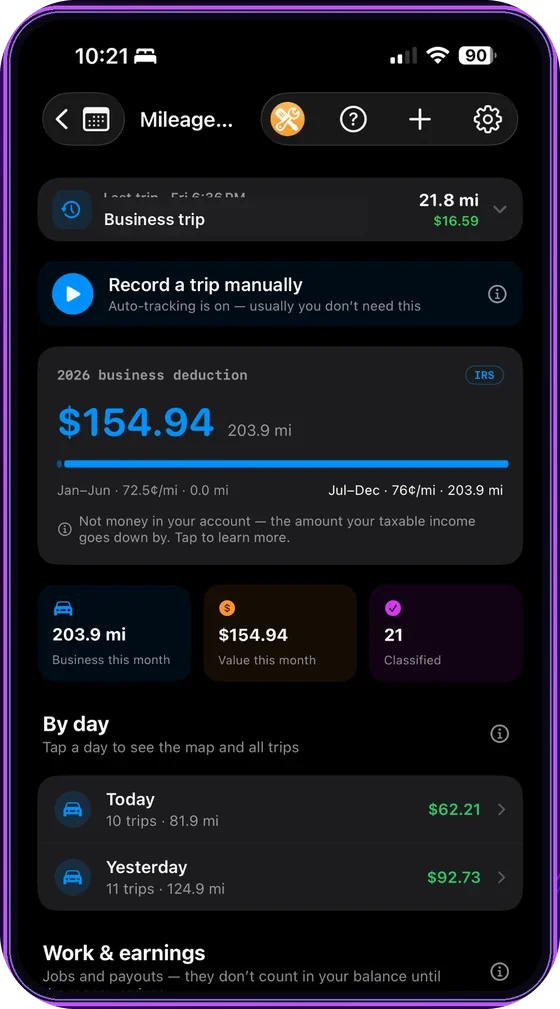
Using an automated tool like VaultHub makes recordkeeping effortless. The iPhone app automatically tracks your drives using motion sensors, tags trips at the exact IRS rate for the trip date—including handling mid-year rate changes automatically—and generates IRS-compliant CSV and PDF reports. All your location data remains stored privately on your iPhone and personal iCloud account.
Drivers can also use the free VaultHub mileage deduction calculator to quickly estimate potential tax savings for the year.
Note: Tax rules vary depending on individual circumstances. For personalized guidance on reporting income and deductions, consult a qualified tax professional.
Track every business mile automatically
VaultHub logs your drives with GPS and applies the IRS rate for each trip's date. Estimate your deduction or get the app.
Sources
- IRS standard mileage rates
- IRS Topic 510, Business use of car
- IRS Publication 463, Travel, Gift, and Car Expenses
- IRS Self-employment tax
General information, not tax advice. Rules can depend on your situation — check with a tax professional.