
Switching Vehicles Mid-Year: How to Claim Mileage
By Egor · Updated · 4 min read · Mileage & taxes

When switching vehicles mid-year, you claim your mileage write-off by keeping separate logs for each car and adding their total deductions together. You must follow the IRS standard mileage rate rules for each vehicle independently, choosing your deduction method in the first year you put each car into business service.
Trading in your work vehicle mid-year introduces a common question for freelancers and gig workers: how do you write off your business miles when you switch cars halfway through the tax year?
The process is straightforward: you track business miles for both vehicles separately and add their deductions together on your tax return. However, you must carefully follow the IRS rules regarding first-year vehicle choices.
Here is how to navigate switching vehicles mid-year tax mileage write off rules without losing money or triggering IRS red flags.
1. Track Each Vehicle Separately
When you swap cars, you cannot lump all your annual miles into a single vehicle entry. The IRS requires recordkeeping per vehicle because each car has its own business use percentage and qualification history.
For both the old car and the new car, your mileage log must record: * Starting and ending odometer readings for the period you drove it. * Date, miles, destination, and business purpose for every work trip made at or near the time of the trip.
Switching work vehicles in the middle of a busy year can make mileage records surprisingly complicated. One simple habit can prevent a lot of confusion: take a photo of your old vehicle's odometer before trading it in, then photograph the new vehicle's odometer when you start using it for business. Keeping those photos alongside your mileage logs and trade-in paperwork makes it much easier to separate the business mileage for each car when tax season arrives.
2. Apply First-Year Mileage Rules to the New Car
To use the business standard mileage rate for a car you own, you generally must choose it in the first year the car is used for business.
If you choose the standard mileage rate for your new car in its first year, you retain the flexibility to switch between the standard rate and actual expenses in future years. If you start with actual expenses (depreciation, fuel, insurance), you might be locked out of using the standard rate for that vehicle later.
For the car you traded in, you simply claim the standard rate for all business miles driven up to the date of the trade-in.
3. Calculate Your Deductions Across Different IRS Rates
IRS standard mileage rates often change year-to-year or even mid-year. For example: * 2025 IRS Rate: 70 cents per mile. * 2026 IRS Rates: 72.5 cents per mile from January 1 through June 30, and 76 cents per mile starting July 1 (raised mid-year due to fuel prices).
If you switched cars mid-year in 2026, you must apply the correct rate to each trip based on when it occurred, regardless of which car you were driving at the time.
Example Calculation (2026 Vehicle Switch)
Imagine you drove an old sedan until May 31, 2026, then traded it in for a small SUV on June 1, 2026:
| Vehicle | Date Range | Business Miles | Applicable IRS Rate | Total Write-off |
|---|---|---|---|---|
| Old Sedan | Jan 1 – May 31 | 5,000 miles | $0.725 / mile | $3,625.00 |
| New SUV | Jun 1 – Jun 30 | 1,000 miles | $0.725 / mile | $725.00 |
| New SUV | Jul 1 – Dec 31 | 8,000 miles | $0.760 / mile | $6,080.00 |
| Total | Full Year | 14,000 miles | Combined | $10,430.00 |
You can estimate your potential tax savings using a free mileage deduction calculator.
4. Remember What Is (and Isn't) Included in the Rate
The standard mileage rate already includes gas, depreciation, insurance, and repairs. You cannot write off gas or repairs for your new vehicle if you use the standard mileage rate.
However, business parking fees and tolls are deductible in addition to the standard mileage rate for both vehicles. Keep separate receipts for parking and tolls incurred with each car.
Remember that driving from home to a regular workplace is generally commuting and not deductible. Driving between work locations or client visits is generally deductible business travel.
5. How Mileage Lowers Self-Employment Tax
For self-employed freelancers and 1099 drivers, business mileage deductions lower your adjusted gross income and your self-employment tax.
Self-employment tax is 15.3% applied to 92.35% of net self-employment earnings. Because your mileage deduction directly reduces net business earnings, every dollar of mileage deduction saves you money on both income tax and self-employment tax.
Note: Most W-2 employees cannot deduct unreimbursed work mileage on their federal return due to changes in tax law.
The week you change vehicles is often the easiest time to lose track of business mileage. Between visiting the dealership, transferring equipment, updating insurance, and continuing regular work trips, manually recording every odometer reading can become a hassle. Automatic mileage tracking helps preserve a consistent trip history through the transition, so you can focus on your work instead of trying to reconstruct missing drives weeks later.
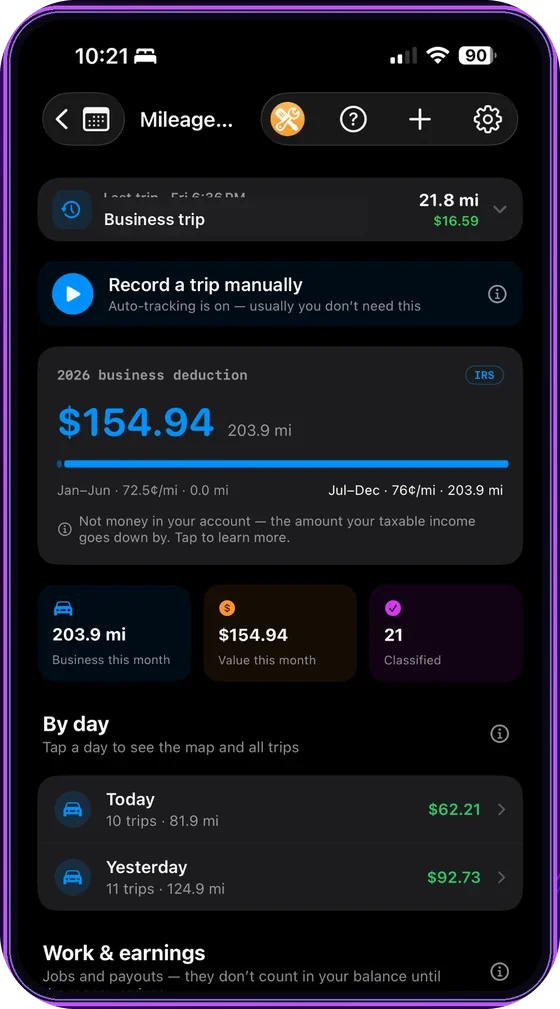
Using an app like VaultHub makes managing mid-year vehicle changes easier. The app uses iPhone motion sensors to log drives automatically, lets you tag trips with one tap, and applies the exact IRS rate for each trip's date—even when rates change mid-year.
Disclaimer: Tax rules can vary depending on your specific business structure or past deduction methods. Consult a qualified tax professional for personalized tax advice.
Track every business mile automatically
VaultHub logs your drives with GPS and applies the IRS rate for each trip's date. Estimate your deduction or get the app.
Sources
- IRS standard mileage rates
- IRS Topic 510, Business use of car
- IRS Publication 463, Travel, Gift, and Car Expenses
- IRS Self-employment tax
General information, not tax advice. Rules can depend on your situation — check with a tax professional.