
Leasing a Car as a Freelancer? Use the IRS Standard Mileage Rate
By Egor · Updated · 5 min read · Mileage & taxes

Yes—you can claim the IRS standard mileage rate on a leased car if you elect the rate in the first year you use the vehicle for business. You’ll deduct the mileage amount, not the lease payments, and must keep a proper log of each business trip.
Can You Use the Standard Mileage Rate on a Leased Car?
The short answer is yes. The IRS does not limit the standard mileage rate to cars you own outright. Whether you own, finance, or lease a vehicle, you may elect to use the standard mileage rate as long as you make the election in the first year the car is used for business. After that, you must stick with the method you chose for the life of the vehicle.
Why the Standard Mileage Rate Still Makes Sense
The rate bundles together the most common operating costs—fuel, insurance, maintenance, depreciation (or lease wear‑and‑tear), and registration. For 2026 the business rate is:
| Period | Rate (cents per mile) |
|---|---|
| Jan 1 – Jun 30 | 72.5 |
| Jul 1 – Dec 31 | 76.0 |
If you drive 1,200 business miles between Jan 1 and Jun 30, the deduction is 1,200 × $0.725 = $870. The same 1,200 miles after July would be $912.
What You Can’t Deduct When Using the Rate
When you claim the standard mileage rate, you cannot also deduct the actual lease payments, gas, insurance, or repairs for that vehicle. Those costs are already factored into the per‑mile number. If you think your real out‑of‑pocket expenses exceed the mileage deduction, you could instead elect the actual expense method, but you must then keep receipts for every cost.
What You Can Add On Top of the Rate
The IRS allows you to deduct business parking fees and tolls in addition to the mileage amount. For example, if you park at a client site for $15 and pay $5 in tolls during a 30‑mile trip, you add $20 to the mileage deduction for that day.
Keeping a Good Mileage Log
A solid log is the backbone of any mileage deduction claim. Each entry should include:
- Date of the trip
- Starting point and destination
- Business purpose (e.g., “Client site – install equipment”)
- Miles driven (odometer start and end or a GPS total)
The log should be recorded at or near the time of the trip. Retroactive entries are frowned upon and can trigger an audit.
Example: Freelance Graphic Designer
- Vehicle: 2025 lease, $350/month
- Business mileage (Jan–Jun 2026): 2,500 miles
- Standard rate: 72.5¢/mile
- Mileage deduction: 2,500 × $0.725 = $1,812.50
- Parking/tolls: $45 total
- Total deduction: $1,857.50
Notice the lease payment of $2,100 (6 × $350) never appears on the Schedule C because the mileage rate already covers the vehicle’s wear and operating costs.
Impact on Self‑Employment Tax
Self‑employment tax is 15.3 % of 92.35 % of net earnings. Every dollar you deduct lowers your net earnings, which in turn reduces the self‑employment tax you owe. In the example above, the $1,857.50 deduction saves roughly $1,857.50 × 0.153 × 0.9235 ≈ $262 in self‑employment tax.
When the Standard Rate Might Not Be Best
If you have unusually high actual expenses—perhaps you drive a high‑maintenance truck, pay high insurance, or your lease includes costly mileage overages—the actual expense method could yield a larger deduction. The trade‑off is more paperwork: you must retain all receipts, allocate personal vs. business use, and calculate depreciation or lease expense yourself.
How VaultHub Can Simplify the Process
Manual logs are easy to start but hard to keep accurate over months of juggling client calls, invoices, and tax paperwork. VaultHub automates the heavy lifting:
- Detects when you start and stop driving using motion sensors.
- Captures the GPS route map for each trip (see screenshot below).
- Lets you tap Business or Personal on the fly; the app instantly applies the correct IRS rate, handling the July 1, 2026 increase.
- Adds parking fees and tolls with a single tap.
- Generates CSV and PDF reports ready for upload to your tax software.
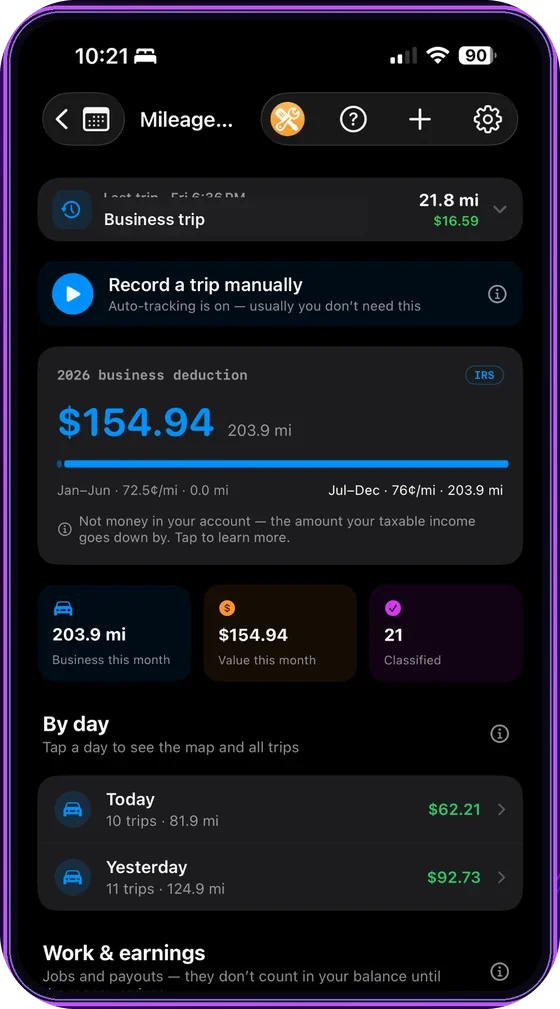
Because VaultHub stores data only on your iPhone and iCloud, you avoid sharing banking credentials while still getting a clean, audit‑ready mileage log.
Quick Checklist for Freelancers with Leased Vehicles
- Elect the mileage rate in the first year you use the car for business.
- Track every business mile with a reliable log or app.
- Add parking and tolls as separate deductible items.
- Keep lease contracts and any related statements in case the IRS asks for proof of vehicle ownership status.
- Re‑evaluate each year—if actual expenses start to outweigh the mileage deduction, consider switching methods.
Bottom Line
Leasing does not bar you from using the standard mileage rate. It can actually be the simplest way to claim a business vehicle deduction, especially when you let a tool like VaultHub do the tracking for you. If your situation is complex—multiple vehicles, mixed personal and business use, or unusually high expenses—consult a tax professional to choose the most advantageous
One thing that often gets overlooked with leased vehicles is how important the initial deduction choice can be. A freelancer driving 15,000 business miles a year may benefit significantly from the standard mileage rate, while someone with fewer business miles and high lease expenses might find the actual expense method more advantageous.
The key is to compare both methods before making your choice. With a leased vehicle, choosing the standard mileage rate generally means using that method throughout the lease, including renewals. Keeping accurate mileage records from the beginning makes it easier to understand the real value of your business driving.
Helpful Resources
- Use the free mileage deduction calculator to estimate your 2026 deduction.
- Explore VaultHub’s mileage tracker page for a deeper dive into features.
- Field technicians can read about specific use‑cases on the field‑technicians page.
“Keeping a daily log was a nightmare until I switched to VaultHub. The app tags each trip with the exact IRS rate, even after the July increase, so my Schedule C is ready in minutes.” — A freelance electrician (example placeholder).
Remember: The IRS requires a contemporaneous log. Whether you write it down on a notebook or let an app record it, consistency is key. Happy driving—and even happier tax savings!
From the road
From the Road A leased car doesn’t have to mean complicated mileage tracking. The important part is knowing which deduction method works for your situation before committing to it. Whether you’re driving for Uber, visiting clients, or making deliveries, tracking your business mileage consistently helps you understand your expenses and prepare for tax season without sorting through months of forgotten trips.
— Egor, maker of VaultHub
Track every business mile automatically
VaultHub logs your drives with GPS and applies the IRS rate for each trip's date. Estimate your deduction or get the app.
Sources
- IRS standard mileage rates
- IRS Topic 510, Business use of car
- IRS Publication 463, Travel, Gift, and Car Expenses
- IRS Self-employment tax
General information, not tax advice. Rules can depend on your situation — check with a tax professional.