
Can Freelancers Deduct Mileage for Unsuccessful Sales Pitches?
By Egor · Updated · 6 min read · Mileage & taxes

Yes. Mileage driven to meet a prospective client is considered a business expense, even if the pitch doesn’t result in a contract. As long as the trip isn’t a regular commute and you keep a proper log, you can claim the IRS standard mileage rate.
Quick answer
You can deduct the miles you drive to a prospective client, even if the meeting doesn’t lead to paid work. The key is that the trip is business‑related, not a regular commute, and that you maintain a contemporaneous mileage log.
What the IRS calls a deductible trip
The IRS treats a vehicle used for business in two ways:
- Commuting miles – from your home to a regular workplace. These are not deductible.
- Business miles – travel between work locations, to client sites, or to prospective clients. These are deductible.
A sales pitch to a potential client falls into the second category because you are performing a business activity: trying to earn income. The fact that the pitch didn’t result in a contract does not change its character.
Which mileage rate applies?
For 2026 the IRS standard mileage rate for business use is:
| Period | Rate per mile |
|---|---|
| Jan 1 – Jun 30 | 72.5¢ |
| Jul 1 – Dec 31 | 76¢ |
If you filed a 2025 return, the rate was 70¢ per mile. Use the rate that matches the date of each trip. The rate already includes gas, insurance, depreciation, and other operating costs, so you don’t add those expenses separately.
Simple math example
Imagine you drove 30 miles round‑trip to a coffee shop where you presented a proposal. The trip happened on May 15, 2026, so the 72.5¢ rate applies:
30 miles × $0.725 = $21.75
You could deduct $21.75 as a business expense on Schedule C. That deduction reduces your net self‑employment income, which in turn lowers the self‑employment tax (15.3% of 92.35% of net earnings).
If the same trip happened on August 10, the rate would be 76¢, yielding a $22.80 deduction.
Keeping a proper mileage log
The IRS requires a log that records, at or near the time of each trip:
- Date of travel
- Starting point and destination
- Business purpose (e.g., "Initial sales pitch for XYZ Corp")
- Miles driven (odometer start and end, or a reliable GPS total)
A good log can be a handwritten notebook, a spreadsheet, or an app that automatically captures the data. The log must be retained for at least three years in case of an audit.
Using an app to simplify tracking
Manual logs are easy to forget, especially when you’re juggling multiple client visits. VaultHub does the heavy lifting:
- It detects motion, records the GPS route, and ends the trip when you park.
- One tap lets you label the trip Business or Personal.
- The app automatically values each trip at the correct IRS rate, handling the mid‑year change for 2026.
- Exportable CSV and PDF reports make it easy to attach mileage data to your tax return.
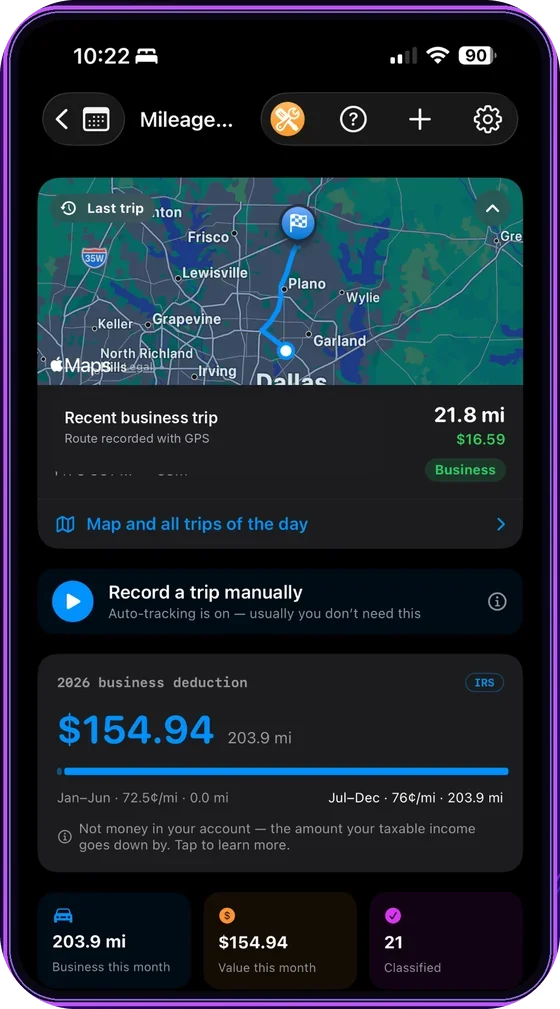
You can also add notes, attach a photo of the client’s address, and see daily totals alongside your earnings. Because VaultHub stores data only on your iPhone and iCloud, you keep control of your information.
When a trip is not deductible
- Home‑to‑regular‑workplace commute – If you have a fixed office you go to daily, that mileage is non‑deductible.
- Personal errands – Even if you run a personal errand on the same day you meet a client, you must separate the business miles from the personal ones.
- Non‑business travel – Attending a conference that is not directly related to your trade, or a vacation, does not qualify.
If any portion of a trip is mixed, you can only deduct the miles that are directly tied to the business purpose.
Impact on self‑employment tax
Self‑employment tax is 15.3% of 92.35% of your net earnings. A $500 mileage deduction reduces net earnings by $500, which in turn reduces the tax by:
$500 × 0.9235 × 0.153 ≈ $70.6
So the deduction does more than just lower your ordinary income tax; it also trims the payroll‑style tax you owe as a freelancer.
Common pitfalls to avoid
| Pitfall | Why it matters |
|---|---|
| Forgetting to label a trip | The IRS may deem it personal if you can’t prove business purpose. |
| Using the wrong rate | Rates change mid‑year; using 72.5¢ for a July trip would under‑claim. |
| Mixing personal and business miles without splitting | You could be forced to disallow the entire trip. |
| Not keeping the log for three years | You risk an audit penalty if you can’t substantiate the deduction. |
Bottom line checklist
- Determine business purpose – Is the trip to meet a prospective client, attend a sales meeting, or deliver a proposal?
- Record the trip immediately – Date, miles, destination, and purpose.
- Apply the correct IRS rate – 72.5¢ before July 1, 76¢ after.
- Sum the deductions on Schedule C – Add the total mileage deduction to other business expenses.
- Keep the log for three years – Store it digitally or on paper.
From the Road — Not Every Business Trip Generates Income
Working as a field service technician in the Dallas area, I've learned that not every business-related trip ends with a paycheck. Sometimes you drive to meet a customer, discuss a potential job, inspect a location, or provide an estimate without getting the actual work.
It's easy to overlook these trips when you focus on earnings rather than expenses. But eligible business mileage matters, even if the visit doesn't result in paid work.
This is one of the reasons I developed VaultHub. Instead of trying to remember every trip at the end of the week, automatic mileage tracking records your drives throughout the day. You can review them, add a business purpose, and classify them when it's convenient.
A few forgotten miles might not seem like much, but over an entire year, they can add up to a meaningful tax deduction.
— Yehor, Field Service Technician & VaultHub Developer
Tools you might find helpful
- Free mileage deduction calculator – Plug in miles and dates to see your potential deduction.
- VaultHub mileage tracker – Automatic logging, one‑tap business classification, exportable reports.
- IRS Publication 463 – Detailed guidance on travel, gift, and car expenses.
When to ask a professional
If you have a mixed‑use vehicle, are unsure whether a particular trip qualifies, or need help integrating mileage deductions with other business expenses, consult a tax professional. They can ensure you maximize deductions while staying compliant.
Quick FAQ
Can I deduct mileage for a pitch that never turned into a contract? Yes. The IRS cares about the purpose of the trip, not the outcome. As long as the travel was to try to earn income, it’s deductible.
Do I need a separate vehicle for business miles? No. You can use the same car for personal and business use, but you must track the miles for each purpose separately.
What if I drove from home to a client’s office that I also use as my regular office? If that location is your regular place of business, the home‑to‑office leg is considered commuting and is not deductible. Subsequent trips between that office and other client sites are deductible.
Can I deduct parking fees and tolls for these trips? Yes. Parking and tolls are deductible in addition to the standard mileage rate.
Do W‑2 employees get the same mileage deduction? Generally no. Most W‑2 employees cannot deduct unreimbursed work mileage on their federal return after the 2018 tax law change.
Track every business mile automatically
VaultHub logs your drives with GPS and applies the IRS rate for each trip's date. Estimate your deduction or get the app.
Sources
- IRS standard mileage rates
- IRS Topic 510, Business use of car
- IRS Publication 463, Travel, Gift, and Car Expenses
- IRS Self-employment tax
General information, not tax advice. Rules can depend on your situation — check with a tax professional.