
How to Split Business and Personal Miles on Your Work Truck
By Egor · Updated · 5 min read · Field technicians

Track every drive, label each trip as business or personal, and use the IRS standard mileage rate for the date of the trip. A good log (date, miles, destination, purpose) lets you claim only the business miles, while personal miles stay non‑deductible.
Why the Split Matters
If you drive a personal truck for plumbing calls, the IRS only lets you deduct the miles that are directly related to your business. Personal trips – like driving to the grocery store or a weekend outing – are not deductible. Mixing the two without clear records can raise red flags in an audit and may cause you to lose valuable tax savings.
The IRS Rules in a Nutshell
- Business mileage gets a standard rate: 72.5¢ per mile from Jan 1‑Jun 30 2026, then 76¢ per mile from Jul 1‑Dec 31 2026. (2025 rate was 70¢.)
- Commuting (home → regular workplace) is not deductible. Driving between job sites is business mileage.
- Parking fees and tolls for business trips are deductible in addition to the mileage rate.
- To claim the standard mileage rate for a vehicle you own, you must elect it in the first year you use the vehicle for business.
- A solid mileage log must show date, miles driven, destination, and business purpose for each trip, recorded at or near the time of travel.
Step‑by‑Step: Separate Business from Personal Miles
- Start a Dedicated Log - Use a paper notebook, spreadsheet, or an app that timestamps each trip. - Record the odometer start and end numbers, or let the app capture total miles.
- Mark the Trip Purpose - Immediately after each drive, note whether it was Business (e.g., “Job #452 – 12 Main St”) or Personal. - For business trips, include a brief description of the work performed.
- Apply the Correct Rate - If the trip occurred before July 1 2026, multiply miles by $0.725. - For trips on or after July 1 2026, use $0.76.
- Add Extra Deductions - Keep receipts for parking fees and tolls tied to each business stop. Add these amounts to your mileage deduction.
- Summarize Monthly - Total business miles, personal miles, and extra fees. - Carry the business total to Schedule C (or the appropriate self‑employment form).
Quick Rate Table
| Period | Standard mileage rate |
|---|---|
| Jan 1 – Jun 30 2026 | $0.725 per mile |
| Jul 1 – Dec 31 2026 | $0.760 per mile |
| 2025 (reference) | $0.700 per mile |
Tools that Make It Easy
Manually writing down every trip can be tedious, especially when you’re juggling multiple service calls. VaultHub’s iPhone app automates the process:
- Automatic trip detection using motion sensors and GPS.
- One‑tap Business/Personal labeling.
- Real‑time calculation of the mileage value at the correct 2026 rate.
- Exportable CSV/PDF reports for your tax prep.
- Integrated finance calendar to see mileage next to bills and budgets.
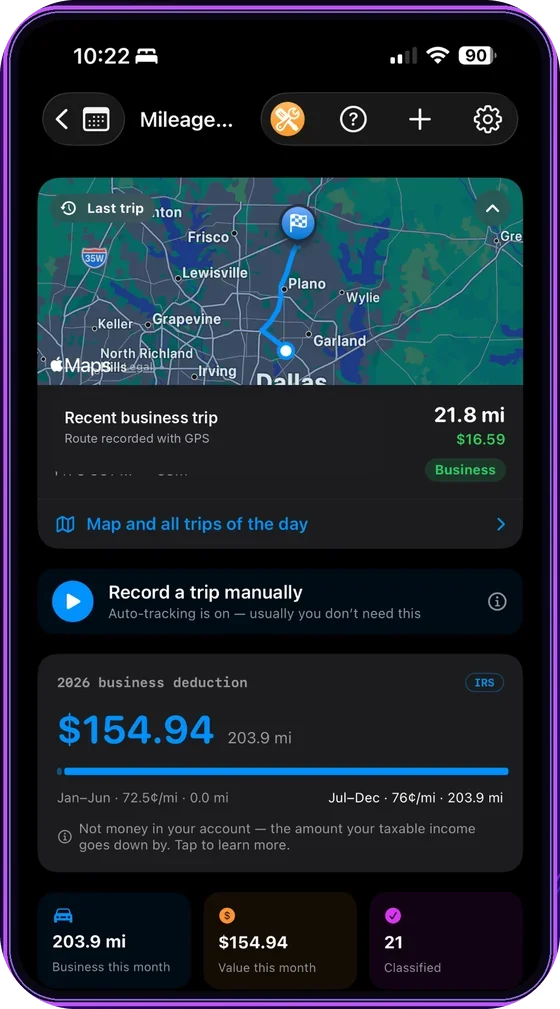
Even if you prefer a spreadsheet, the app’s export function lets you import the data directly.
Real‑World Example (Insert Your Story)
Real-World Example: A Busy Day for a Field Technician
Consider a field technician handling three customer appointments in one day. After completing the first job, they drive 18 miles to the second customer, make an 11-mile trip to pick up supplies, and then travel another 14 miles to the final appointment.
That’s 43 business miles between work locations, excluding personal driving and commuting.
Using VaultHub, the technician can review each recorded trip and mark it as Business or Personal. At the July–December 2026 IRS rate of $0.76 per mile, those 43 business miles represent a $32.68 potential deduction.
Over a five-day workweek, imagine the technician records 192 eligible business miles. That’s $145.92 in mileage deductions, plus any qualifying parking fees and tolls.
The biggest advantage is consistency. Instead of trying to remember every stop at the end of the week, the technician has a record of the trips to review and classify.
Common Pitfalls and How to Avoid Them
| Mistake | Why It’s a Problem | Fix |
|---|---|---|
| Using the standard mileage rate for a car you didn’t elect in the first year | You lose the ability to claim the rate for that vehicle | Choose the rate in the first year you use the truck for business; otherwise switch to actual expense method. |
| Forgetting to record personal trips | Personal miles may be mistakenly counted as business, leading to an audit | Mark every drive as Business or Personal right after the trip. A quick “Business” tap in VaultHub saves time. |
| Ignoring parking and toll receipts | You miss out on additional deductions | Keep a small envelope in the truck for receipts; enter them into your log weekly. |
How the Deduction Impacts Your Taxes
Business mileage reduces your net self‑employment income, which lowers both income tax and the self‑employment tax (15.3% of 92.35% of net earnings). For example, 1,000 business miles in the first half of 2026 equal a $725 deduction. That $725 reduces the amount subject to the 15.3% SE tax, saving you roughly $111 in SE tax alone (15.3% × 0.9235 × $725). The exact saving depends on your overall tax situation, so consult a tax professional.
When to Seek Professional Help
If you have mixed‑use vehicles, lease arrangements, or you’re unsure whether a particular trip qualifies as business, a tax professional can help you apply the rules correctly.
Quick Checklist Before Filing
- [ ] All trips labeled Business or Personal with date, miles, destination, purpose.
- [ ] Parking and toll receipts attached to the corresponding business trips.
- [ ] Mileage totals calculated using the correct 2026 rate for each date.
- [ ] Exported CSV/PDF report saved for your records (keep for at least three years).
- [ ] Schedule C (or applicable form) reflects the total business mileage deduction.
Bottom Line
Separating business and personal miles is straightforward if you log each drive at the time of travel and apply the IRS standard mileage rate for the appropriate period. Automation tools like VaultHub simplify the process, ensure accuracy, and give you ready‑to‑file reports. Stay organized, keep receipts, and let the numbers do the work for you.
Helpful Links
- Try the free mileage deduction calculator to see your potential savings.
- Learn more about the VaultHub mileage tracker.
- Resources for field technicians: field‑technicians.
From the road
From the Road When you’re working multiple service calls every day, it’s easy to forget how much driving happens between customers, supply houses, and equipment pickups. Keeping business and personal mileage separate makes tax preparation much easier. Automatic trip tracking helps you capture the driving history, while reviewing and categorizing each trip ensures you’re only claiming legitimate business miles.
— Egor, maker of VaultHub
Track every business mile automatically
VaultHub logs your drives with GPS and applies the IRS rate for each trip's date. Estimate your deduction or get the app.
Sources
- IRS standard mileage rates
- IRS Topic 510, Business use of car
- IRS Publication 463, Travel, Gift, and Car Expenses
- IRS Self‑employment tax
General information, not tax advice. Rules can depend on your situation — check with a tax professional.