
Standard Mileage vs. Actual Expenses for 1099 Installers
By Egor · Updated · 5 min read · Field technicians

For most 1099 installers, the standard mileage rate often yields a bigger deduction because it bundles fuel, insurance, repairs and depreciation into a single per‑mile number. However, if your actual costs (gas, insurance, repairs, depreciation) are unusually high, the actual expense method can beat the mileage rate. Run the numbers each year and pick the larger amount.
Quick recap: two ways to write off your vehicle
- Standard mileage rate – You multiply every business mile by the IRS‑published cents‑per‑mile amount. In 2026 it’s 72.5¢ per mile for trips Jan 1‑Jun 30 and 76¢ per mile for trips Jul 1‑Dec 31. Parking fees and tolls are added on top.
- Actual expense method – You total every cost you actually paid for the car (fuel, insurance, repairs, depreciation, lease payments, registration, etc.) and then allocate the portion that relates to business use.
Both methods lower your net self‑employment income, which reduces the 15.3% self‑employment tax applied to 92.35% of that income. The bigger the deduction, the more you keep.
How the standard mileage rate works in practice
Let’s say you drive 10,000 business miles in 2026. Because the rate changed mid‑year, you split the miles evenly:
| Period | Miles | Rate | Deduction |
|---|---|---|---|
| Jan‑Jun | 5,000 | $0.725 | $3,625 |
| Jul‑Dec | 5,000 | $0.760 | $3,800 |
| Total | 10,000 | — | $7,425 |
Add any parking fees or tolls you paid on the road, and that amount is fully deductible. You don’t need to keep receipts for fuel, insurance, or repairs because they’re already baked into the per‑mile rate.
Why many contractors love it
- Simplicity – One mileage log, no pile of receipts.
- Predictability – The deduction is a straight line: more miles = more deduction.
- Immediate tax impact – You can claim the deduction on your Schedule C the same year you drive.
Log it right
The IRS requires a contemporary mileage log: date, miles, destination, and business purpose for each trip. A good habit is to record the trip right after you finish the job or use an automatic tracker.
The actual expense method broken down
If you prefer to track every dollar you spend on the vehicle, you’ll need to total the following (example numbers, replace with your own):
- Gas: $0.15 per mile × 10,000 miles = $1,500
- Insurance: $1,200 per year
- Repairs & maintenance: $500
- Depreciation (or lease): $2,000
- Registration & fees: $150
Total car costs: $5,350
Now calculate the business‑use percentage. If the car is used 100 % for work (common for installers who drive only between jobs), the full $5,350 is deductible. If you also use it for personal errands, you’d allocate proportionally (e.g., 80 % business use = $4,280).
When the actual method wins
Compare the two totals: * Standard mileage deduction: $7,425 * Actual expenses (100 % business): $5,350
In this scenario, the mileage rate is clearly better. The actual method would only beat the mileage rate if your real costs exceed the mileage deduction. For example, if gas spiked to $0.30 per mile, fuel alone would be $3,000, pushing total actual costs above $7,425.
Decision checklist for 1099 field technicians
- How many business miles do you drive? * 5,000‑7,000 miles per year usually favor the mileage rate. * Over 12,000‑15,000 miles can still favor mileage, but high fuel or repair costs may tip the balance.
- What’s your vehicle’s cost structure? * Newer cars have higher depreciation; older cars may have lower fuel costs. * If you own a fuel‑guzzler (e.g., a large service van) and gas prices are high, actual expenses can outpace the mileage rate.
- Do you keep receipts? * The mileage method needs only a mileage log. * The actual method demands receipts for every gas fill‑up, insurance payment, repair invoice, etc.
- When did you first use the car for business? * To claim the mileage rate for a personally owned car, you must choose it in the first year you use the car for business. After that, you can switch to actual expenses, but you can’t go back to mileage for that vehicle.
- Do you have other deductible vehicle costs? * Parking fees and tolls are always deductible on top of the mileage rate—don’t forget to log them.
If you’re still unsure, run both calculations at the end of the year. The IRS allows you to compare methods and choose the larger deduction for that tax year.
Tools that make the math painless
Manually logging every trip and sorting receipts can feel like a second job. That’s where a dedicated mileage app can save time and reduce errors.
- Automatic mileage tracking – The app detects motion, records the GPS route, and ends the trip when you park.
- One‑tap business/personal flag – Each trip is instantly labeled, and the app applies the correct 2026 rate (handling the July rate change automatically).
- Integrated deduction view – See your year‑to‑date deduction value without doing the math yourself.
- Exportable reports – CSV or PDF files ready for your accountant.
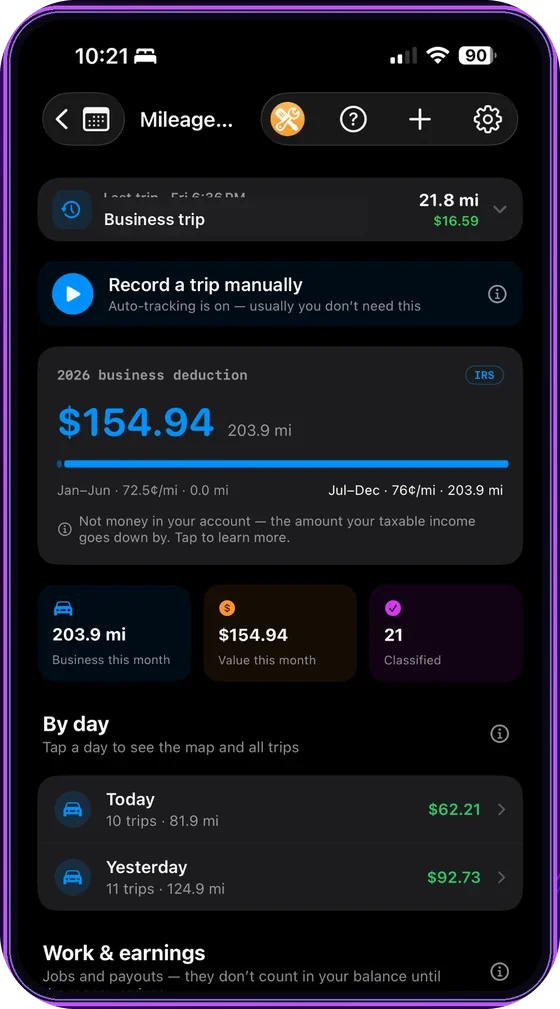
The same app also includes a finance calendar, so you can view daily mileage next to upcoming bills or loan payments, helping you stay on top of cash flow.
Bottom line for 1099 installers
- Start with the standard mileage rate – It’s easy, requires fewer records, and often yields the larger deduction.
- Switch to actual expenses only if your fuel, insurance, repairs, or depreciation are significantly higher than the per‑mile value.
- Keep a solid mileage log regardless of the method; the IRS can ask to see it.
- Consult a tax professional if you have mixed‑use vehicles, large depreciation schedules, or unusual expenses.
Consider a field technician handling three service calls in one busy day. Between customer locations and a quick stop at a supply house, they record 39 eligible business miles and spend $12 on parking. At the July–December 2026 IRS rate of 76 cents per mile, that represents $29.64 in mileage deductions plus $12 in parking expenses.
Now imagine an unexpected $425 vehicle repair during the same week. That expense might make the actual expense method worth comparing, but it cannot be added separately when using the standard mileage rate. This is why keeping track of both business mileage and actual vehicle costs can help contractors make a more informed tax decision.
By running both numbers each year and using an automatic tracker, you can be confident you’re taking the deduction that saves you the most money.
Quick resources
- Free mileage deduction calculator
- Learn how to set up the VaultHub mileage tracker: /mileage-tracker/
- Read more about the standard mileage rate and its rules: IRS standard mileage rates
Remember: a larger vehicle expense deduction lowers your taxable self‑employment income, which reduces both income tax and the 15.3% self‑employment tax you owe.
From the road
From the Road For field technicians, it’s often the short trips between service calls that are easiest to forget. A quick drive to pick up parts or visit another customer may seem insignificant, but those miles accumulate over hundreds of working days. The best approach is to keep consistent records throughout the year rather than trying to recreate everything at tax time. An automatic mileage tracker can make that process significantly easier.
— Egor, maker of VaultHub
Track every business mile automatically
VaultHub logs your drives with GPS and applies the IRS rate for each trip's date. Estimate your deduction or get the app.
Sources
- IRS standard mileage rates
- IRS Topic 510, Business use of car
- IRS Publication 463, Travel, Gift, and Car Expenses
- IRS Self-employment tax
General information, not tax advice. Rules can depend on your situation — check with a tax professional.