
What the IRS Requires in a Field Tech Mileage Log Audit
By Egor · Updated · 5 min read · Field technicians

If the IRS audits your vehicle deductions, they require contemporary proof showing the date, exact mileage, destination, and business purpose for every trip. Reconstructed logs created at tax time or rounded estimates are frequently rejected, leading to back taxes and penalties.
If you receive an audit letter from the IRS questioning your vehicle expenses, they are looking for specific documentation required under federal tax law. For 1099 field service technicians—like HVAC techs, plumbers, electricians, and cable installers—vehicle mileage is often the single largest tax deduction. Losing it due to poor recordkeeping can cost thousands of dollars.
Here is a breakdown of what the IRS actually demands when auditing a vehicle log, how the math works, and how to protect your tax savings.
For independent field technicians, reconstructing an entire year of driving from old work orders can be a major challenge. Even when job addresses are available, proving the exact mileage and business purpose of every trip becomes much harder months later.
The 4 Essential Elements of an IRS-Compliant Mileage Log
Under IRS rules (specifically Publication 463), an audit requires a log kept at or near the time of the trip. A spreadsheet typed up in April for the previous tax year rarely passes scrutiny. For every single business trip, your log must record:
- Date: The exact day of the drive.
- Mileage: The actual distance driven (or starting and ending odometer readings).
- Destination: The city, town, or specific job site location.
- Business Purpose: The reason for the trip (e.g., "HVAC repair at customer site" or "Parts pickup at distributor").
What Fails an Audit?
- Estimates and rounded numbers: Claiming exactly 50 miles every single day suggests guessing.
- Lacking business purpose: Writing "work" or "driving" for every entry is often deemed too vague.
- Reconstructed logs: Recreating 300 trips at the end of the year using calendar notes usually fails unless supported by third-party receipts.
Driving Types: What Counts as Business Mileage?
Not every mile driven in your work vehicle qualifies for a tax deduction. The IRS strictly separates commuting from business travel.
- Home to First Stop (Commuting): Driving from your home to your first regular job site or workplace is generally personal commuting and is not deductible.
- Stop-to-Stop (Business): Driving from customer A to customer B, or from a job site to a supply house, is deductible business mileage.
- Final Stop to Home (Commuting): Driving from your last job site back to your home is generally non-deductible commuting.
If you maintain a qualified home office as your principal place of business, driving from home to your first customer call may qualify as business mileage. Consult a tax professional to see if your setup meets home office rules.
How Much Is Your Mileage Log Worth?
For 1099 contractors, every business mile lowers both your income tax and your self-employment tax. Self-employment tax is 15.3% applied to 92.35% of your net self-employment earnings.
Here is how the official standard mileage rates add up:
| Tax Period | Rate Per Mile |
|---|---|
| 2025 (Full Year) | 70.0 cents |
| 2026 (Jan 1 – Jun 30) | 72.5 cents |
| 2026 (Jul 1 – Dec 31) | 76.0 cents |
Note: The IRS increased the rate mid-year in 2026 to account for rising fuel prices.
Simple Math Example for 2025
If you logged 15,000 legitimate business miles between service calls in 2025: * 15,000 miles × $0.70 = $10,500 business deduction.
If an audit disallows those 15,000 miles because you lacked a detailed log, that $10,500 is added back to your taxable net income, triggering substantial back taxes, self-employment tax, and potential penalties.
Other Deductions: Parking and Tolls
When using the standard mileage rate, items like gas, oil changes, vehicle insurance, repairs, and depreciation are already factored into the per-mile rate. You cannot deduct gas receipts on top of the standard mileage rate.
However, business parking fees and tolls are separately deductible in addition to the standard mileage rate. Keep digital or physical receipts for tolls and parking meters encountered while traveling between job sites.
Standard Mileage Rate vs. Actual Expenses
To use the standard mileage rate for a car you own, you generally must choose it in the first year the car is available for business use. In later years, you can switch between the standard rate and actual vehicle expenses (subject to certain rules). If you start with actual expenses in year one, you may be locked out of using the standard mileage rate for that vehicle.
Note for W-2 Employees: Under federal tax law changes that took effect in 2018, most W-2 employees cannot deduct unreimbursed employee expenses (including mileage) on their federal tax returns. These mileage rules primarily benefit 1099 independent contractors and self-employed service technicians.
How Modern Apps Simplify Audit Proof
Paper logbooks left on the dashboard frequently get lost, damaged, or forgotten during a busy workday. Using an automated app ensures every trip is recorded with exact GPS data as it happens.
Short trips between customer locations, supply houses, and equipment distributors are easy to overlook during a busy workday. Just a few forgotten trips each week can add up to hundreds of unrecorded business miles over a year.
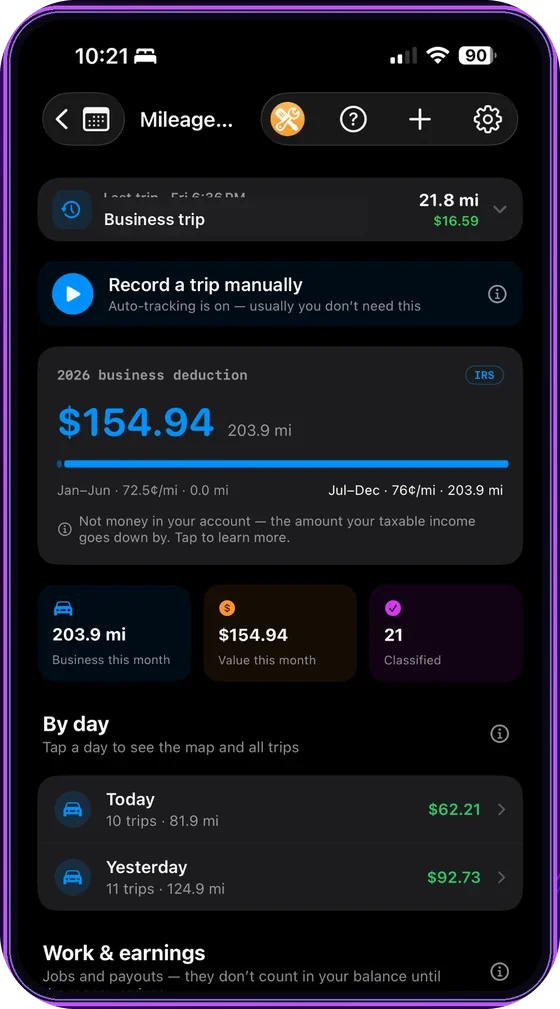
Apps like VaultHub automatically record drives using motion sensors, log GPS route maps, and end trips when you park. You can mark drives as business or personal with a single tap, applying the correct rate—including mid-year rate adjustments like the 2026 mid-year increase. You can generate CSV and PDF mileage reports ready for your accountant or an auditor, while keeping your data private on your iPhone and personal iCloud.
You can also estimate your potential tax savings with a free mileage deduction calculator before tax season arrives.
Keeping detailed records at the time of travel is your best defense against an IRS audit. Track every stop, note the business purpose, and retain any parking or toll receipts to lock in your hard-earned deductions.
Track every business mile automatically
VaultHub logs your drives with GPS and applies the IRS rate for each trip's date. Estimate your deduction or get the app.
Sources
- IRS standard mileage rates
- IRS Topic 510, Business use of car
- IRS Publication 463, Travel, Gift, and Car Expenses
- IRS Self-employment tax
General information, not tax advice. Rules can depend on your situation — check with a tax professional.