
Average Mileage Deduction for Appliance Repair Techs
By Egor · Updated · 5 min read · Field technicians

Independent appliance repair technicians often drive thousands of miles per year driving between customer service calls. At the IRS standard mileage rates, these business miles create a tax write-off worth thousands of dollars that reduces both income tax and self-employment tax.
If you work as an independent 1099 appliance repair technician or field service contractor, your vehicle is one of your biggest business tools. Driving from one job site to another adds up quickly, but every business mile you drive can help lower your federal tax bill.
Here is a breakdown of how driving between service calls turns into a tax write-off, how much that deduction can be worth, and how to track your trips correctly.
How Business Mileage Adds Up for Independent Techs
Unlike W-2 employees, 1099 independent contractors pay self-employment tax in addition to income tax. Because most W-2 employees cannot deduct unreimbursed work mileage on their federal returns due to tax law changes, independent field technicians gain a significant advantage by claiming every eligible business mile.
Your main tax deduction comes from driving between work locations. For example, driving from one customer's home to inspect a refrigerator to another house to repair a dryer counts as deductible business mileage.
However, driving from your home to your first regular work location of the day—or driving back home at the end of the shift—is generally considered commuting and is not deductible under IRS rules.
As a field technician working in the Dallas–Fort Worth area, I know how quickly mileage adds up when your job requires traveling between customer locations. A typical field service schedule might include four to six appointments across different neighborhoods, plus occasional stops to pick up equipment or replacement parts.
Depending on the service area, driving 50 to 100 business miles in a single day is entirely possible. Over an entire year, those trips can add up to thousands of dollars in potential tax deductions. That's why tracking mileage consistently is so important for independent contractors.
What Is the IRS Mileage Deduction Worth?
To figure out what your write-off is worth, you multiply your total business miles by the IRS standard mileage rate for the date of the trip.
The IRS sets these rates annually (and sometimes mid-year): - 2025 Rate: 70 cents per mile. - 2026 Rate (Jan 1 – Jun 30): 72.5 cents per mile. - 2026 Rate (Jul 1 onward): 76 cents per mile (raised mid-year by the IRS due to fuel prices).
Doing the Math on Your Mileage Deduction
Let's look at simple examples to see how the math works for an independent field tech.
Example 1: 15,000 Business Miles in 2025
If you logged 15,000 business miles between service calls in 2025: * 15,000 miles × $0.70 = $10,500 tax deduction
Example 2: 15,000 Business Miles in 2026
If you log 15,000 business miles in 2026, split evenly with 7,500 miles in the first half of the year and 7,500 miles in the second half: * First half: 7,500 miles × $0.725 = $5,437.50 * Second half: 7,500 miles × $0.76 = $5,700.00 * Total write-off: $11,137.50 tax deduction
Don't Forget Self-Employment Tax Savings
Your mileage deduction does not just lower your regular income tax—it also lowers your self-employment tax. Self-employment tax is 15.3% applied to 92.35% of your net self-employment earnings.
When a $10,000 mileage write-off reduces your net earnings, it saves you roughly $1,413 in self-employment tax alone (calculated as $10,000 × 92.35% × 15.3%), before even counting income tax savings.
What Is Included in the Standard Rate?
When you use the IRS standard mileage rate, it already covers all your regular vehicle operating costs, including: * Gasoline and oil * Insurance * Repairs and maintenance * Vehicle depreciation
Because these expenses are built into the rate, you cannot write off gas receipts or oil changes separately if you use the standard rate.
Extra Expenses You Can Claim
Even when using the standard mileage rate, certain out-of-pocket costs are deductible separately: * Business parking fees * Tolls paid while driving for work
Keep track of these receipts alongside your mileage log to maximize your return.
| Expense Category | Included in Standard Rate? | Deductible Separately? |
|---|---|---|
| Fuel & Gas | Yes | No |
| Vehicle Insurance | Yes | No |
| Repairs & Tires | Yes | No |
| Tolls & Parking | No | Yes |
Note: Rules depend on your individual tax situation. Consult a tax professional for personalized guidance. If you plan to use the standard mileage rate for a car you own, you generally must choose it in the first year the car is used for business.
IRS Requirements for a Compliant Mileage Log
To claim your business mileage deduction without trouble during an audit, the IRS requires an accurate log created at or near the time of the trip.
Your log must record four essential details for every business trip: 1. Date of the trip 2. Number of miles driven 3. Destination or location visited 4. Business purpose (e.g., "Appliance repair call - client service")
One of the biggest challenges of working in field service is remembering to track mileage while managing customer appointments, equipment, work orders, and unexpected schedule changes.
When you're rushing to your next appointment, recording your odometer reading is probably the last thing on your mind. Automatic mileage tracking helps eliminate that extra task, allowing you to focus on completing jobs while keeping a more consistent record of your business travel.
How to Keep Log Tracking Simple
Stopping to write down odometer readings after every repair call takes time away from your work. Using an automatic log app built for field technicians simplifies the process.
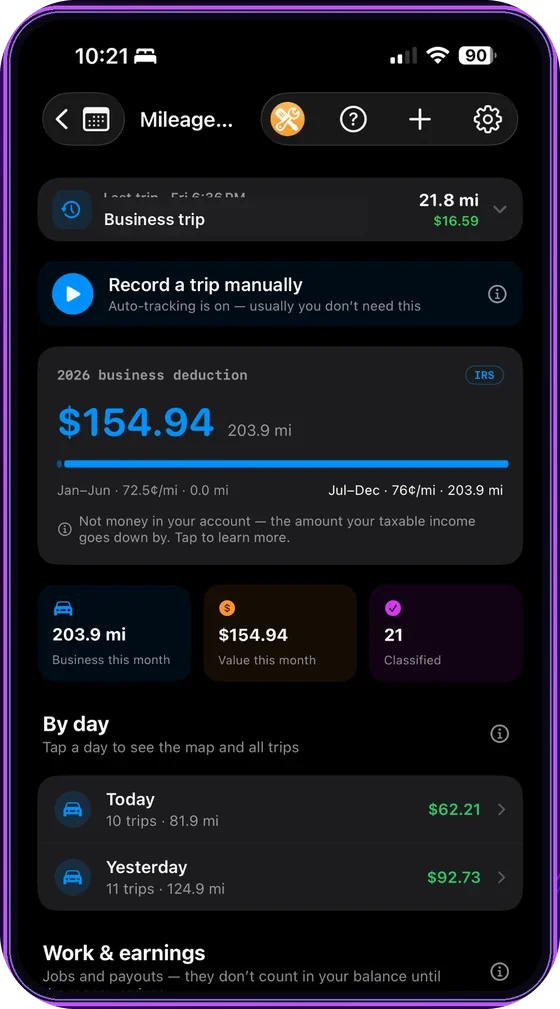
For example, VaultHub automatically detects drives using your iPhone's motion sensors, logs GPS route maps, and stops the trip when you park. You can review your drives and swipe with one tap to mark trips as Business or Personal. The app calculates trip values using the correct IRS rates for specific dates—even applying mid-year updates like the 2026 rate change.
You can also calculate potential write-offs anytime with a free mileage deduction calculator or export ready-to-use CSV and PDF reports when tax season arrives.
Keeping detailed logs of every drive between job stops ensures you claim every dollar you earned while driving.
From the road
### From the Road — A Field Technician’s Perspective As a field service technician working with coax and fiber in the Dallas area, I know how quickly business mileage can add up. Between customer appointments, supply stops, and driving across different service areas, it's easy to lose track of individual trips. When you're focused on completing jobs and getting to your next customer on time, manually recording every drive is probably the last thing on your mind. That's why automatic mileage tracking makes so much sense for independent contractors. You can focus on your work while keeping an accurate record of your business trips throughout the year. Every eligible business mile matters, especially when tax season comes around. — Denis, Field Service Technician & VaultHub Developer
— Egor, maker of VaultHub
Track every business mile automatically
VaultHub logs your drives with GPS and applies the IRS rate for each trip's date. Estimate your deduction or get the app.
Sources
- IRS standard mileage rates
- IRS Topic 510, Business use of car
- IRS Publication 463, Travel, Gift, and Car Expenses
- IRS Self-employment tax
General information, not tax advice. Rules can depend on your situation — check with a tax professional.